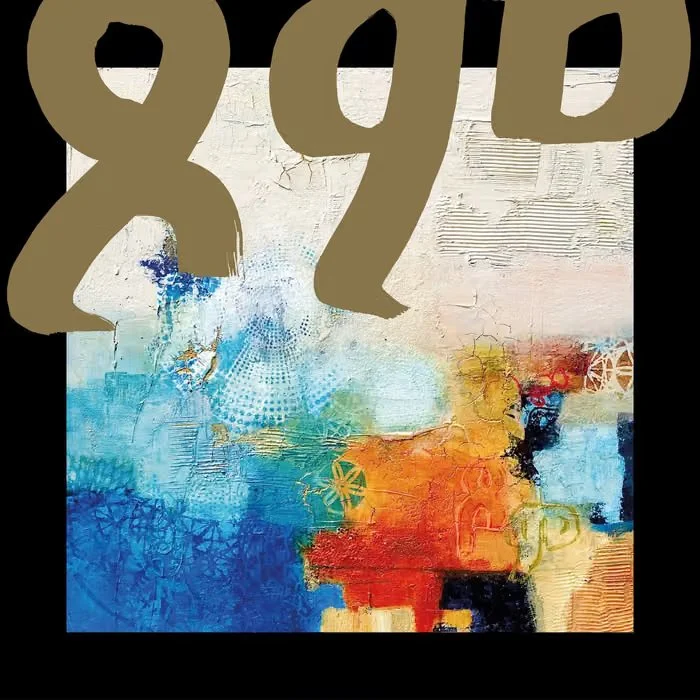
Album Painting by Elsa Gebreyesus
T'SOM Credits | Liner Notes:
1. MARCH OF THE ASCARIS (FEATURING CARLOS NIÑO, SURYA BOTOFASINA AND KALEAB SENAI)
Alan Lightner – Additional kebero
Carlos Niño – Percussion
Gebre Woldegebriel – Tigrinya end vocal
Kaleab Senai – Chira wata, Vocals
Surya Botofasina – Keys
Dexter Story – All other instruments, shouts and field recordings
2. THE TIGRE SONG (FEATURING GEORGIA ANNE MULDROW AND ROBEL)
Georgia Anne Muldrow – Vocals, Congas, Handclaps
Kibrom Birhane – Kirar, Synthesizer
Robel – Vocals
Dexter Story – All other instruments, vocals and field recordings
3. MAMA (FEATURING SUDAN ARCHIVES AND KAMASI WASHINGTON)
Kamasi Washington – Tenor saxophone
Mohammed “Moe” Saleh – Arabic vocal
Sudan Archives – Vocals, Violin
Dexter Story – All other instruments, vocals and field recordings
Additional mixing by Zé Nando Pimenta
4. FIAT (FEATURING KIBROM BIRHANE)
Kibrom Birhane – Vocals, Synthesizer
Yusra Mohammedsalh – Vocals
Dexter Story – All other instruments, vocals and field recordings
Additional mixing by Zé Nando Pimenta
5. ERMIAS (FEATURING LUWAM THOMAS)
Kaleab Senai – Chira wata, Shouts
Kibrom Birhane – Synthesizer
Luwam Thomas – Vocals, Keyboards
Mocky – Piano
Dexter Story – All other instruments and field recordings
Additional mixing by Zé Nando Pimenta
6. SAMAYAWI (FEATURING JIMETTA ROSE & THE VOICES OF CREATION AND NICOLE MITCHELL)
Dereje Zemedu – Kebero drums
Jimetta Rose – Adlib lead vocals, Choir direction
Kibrom Birhane – Amharic vocal
Nicole Mitchell – Flute
Voices of Creation – Choir
Dexter Story – All other instruments, vocals and field recordings
7. BEH JEH XI (BE MY BABY)
Fanny Franklin – Background vocals
Kibrom Birhane – Kirar
Mocky – Piano, Drums, Percussion, Additional bass guitar
Dexter Story – All other vocals, instruments and field recordings
Additional mixing by Zé Nando Pimenta
8. ETHIOPIANISM (DO YOU BELIEVE?)
Kibrom Birhane – Kirar
Rahel Lulseged – Cello
Randal Fisher – Tenor saxophone, Flute
Dexter Story – All other instruments, vocals and field recordings
9. EULOGY FOR EL DIN (FEATURING YUSRA MOHAMMEDSALEH)
Miguel Atwood-Ferguson – Viola, Violin, Efx
Randal Fisher – Tenor saxophone
Yusra Mohammedsaleh – Vocals
Dexter Story – All other instruments, vocals and field recordings
Additional radio vignette production – Ken Barrientos
10. SAWM (THE FAST)
Dexter Story – All instruments, vocals and field recordings
Produced by Dexter Story and Carlos Niño
Additional Production by Dominic “Mocky” Salole (on tracks 3, 4, 5, 7 and 8)
Mixed by Dexter Story and Ken Barrientos
Fasting is a long-standing spiritual practice across northeast Africa, and other enlightened parts of the world. It is the discipline of doing without in order to do work within. T’som (pronounced sawm) names this practice of abstention in the Afro-Semitic languages Tigrinya and Amharic, as well as in Arabic. In these cultural traditions, fasting marks a holy period of prayer, reflection and community. I came to see this practice as resonant with my musical journey and the music gathered here grew out of that sensibility.
Album release date: 30 October 2026
T'SOM TRACK DESCRIPTIONS
T'som (pronounced sawm) takes its name from the Afro-Semitic and Arabic practice of spiritual fasting — a discipline rooted in abstention, interior focus, and communal devotion across the Horn of Africa. That discipline describes less a theme running through every track than the posture behind how this album was made: years of patient fieldwork and archival research, deferred conclusions, and close listening across Eritrea, Ethiopia, Sudan, Somalia, and the diaspora. The album was produced by me and Carlos Niño, whose ear for sequencing and sonic cohesion helped synthesize the record’s wide range of collaborators into a unified whole. The album’s closing track returns explicitly to fasting itself — its sounds, its texture, its meaning — as the deliberate culmination of that process. What follows is a momentary track-by-track account of the field research, historical artifacts, and collaborative encounters that shaped this work.
1. March of the Ascaris
featuring Carlos Niño and Surya Botofasina
“March of the Ascaris” originates from an Italian postcard, acquired on eBay, depicting a group of Eritrean men seated among large drums. Photographed in Asmara during the Italian colonial period (1896–1941) and captioned “Concerto,” the image documents a gathering that is neither religious nor martial in the conventional sense — a scene that resists easy classification within the available visual record of ascari life.
The track uses this Italian postcard ephemera as a conceptual point of departure, asking what Eritrean ascari soldiers might have sounded like performing their own traditional music rather than the European fife-and-drum repertoire popularly preserved in the archive. It opens the album with a thunderous guayla rhythm, the dominant beat of the Tigrinya ethnic group and a central subject of my research. Carlos Niño and Surya Botofasina, joined by Eritrean instrumentalist Kaleab Senai and some embilta field recordings, shape the track’s harmonic dimensionality and momentum.
In the course of fieldwork in Eritrea, I repeatedly encountered guayla carrying across distance — a rhythm immediately legible as a communal signal. Artist and entrepreneur Aron Tadesse (Cafe Industry and Jazz) has described a similar experience from his childhood in Ghindae, where the pulse of guayla was audible for miles and functioned as a call for all to gather. The track poses the question directly: could guayla have operated not only as a festive pulse but as a subaltern call to arms or to resistance? “March” is offered as one possible answer.
2. The Tigre Song
featuring Georgia Anne Muldrow and Robel
“The Tigre Song” draws on stalileh (also noted as guweyla), a rhythm associated with the Tigre people, historically known as the Beni Amer. Stalileh is distinct from Tigrinya guayla — a related but separate rhythmic tradition, increasingly prominent in Eritrea and its diaspora for its danceability and broad appeal.
The idea developed during repeated visits to music events at the Asmara Expo Grounds and in local clubs, where a song titled “Telay Massenqo,” written and performed by Suleman Ahmed, dominated the airwaves and consistently drew crowds to its feet. Late one night, inspired by the track’s hold on the room, I retired to my hotel room and recorded an original vocal riff into my phone; that recording appears as a sound clip in the track’s intro.
My understanding of the Tigre stalileh tradition owes a great deal to my friendship with Eritrean musician and educator Mohammedsaleh Hussein and his family, who are Tigre. Through them I came to understand the rhythm's dual role: customary at weddings, where it carries associations of love and celebration, and also historically mobilized during the country’s revolutionary period. Georgia Anne Muldrow contributes congas and vocals; Kibrom Birhane adds strummed kirar and analog synthesizer. The wedding association surfaces directly in Robel’s vocal — a groom’s unguarded joy on his wedding day, watching his bride approach. He sings:
“Never did I think I would see this day / White dress on your body / Put tears on my face / Rest of our lives starting today / Sun on the mountain, it's shining our way / Never did I think I would see this day.”
Together these featured guests anchor the social vibrancy of “The Tigre Song.”
3. Mama
featuring Sudan Archives and Kamasi Washington
“Mama” grew out of an ongoing friendship and creative exchange with Sudan Archives, whose organological musicianship and global artistry have informed my own approach to composition. We were introduced by photographer, DJ, and curator Eric “Ecoleye” Coleman at a Mount Washington festival event, and have since exchanged melodies and artistic support over several years.
The track explores a derivative sera pulse, a rhythm associated with urban outdoor music settings in Sudan, traditionally danced with an undulating motion of the chest and body. The arrangement does not claim strict authenticity to the tradition; rather, it allows the rhythm to underscore Sudan Archives’ voice and violin, foregrounded in a personal, derivative treatment of classical Sudanese musical idioms. Kamasi Washington’s tenor saxophone adds a further layer of virtuosic detail.
I have always attempted to connect Sudan Archives’s stage name with my longstanding interest in Sudanese music and culture. The refrain — “Mama, I didn't mean to scare you” — speaks to the tension between a child's creative path and a parent’s protective instinct, and carries a literal resonance: I have, on more than one occasion, unintentionally startled my deaf, 90-year-old mother by arriving at her home unannounced.
4. Fiat
featuring Kibrom Birhane
Fiat is a landmark building in Asmara, commissioned under Italian colonial rule and completed in 1938. Designed by architect Giuseppe Pettazzi as a former service station for the automobile company sharing its name, the structure’s cantilevered wings — built without truss support — were widely doubted at the time of construction. Local oral history holds that Pettazzi confronted the foreman at gunpoint to ensure the project’s completion, and that he stood on one of the wings with the revolver to his own head as the supporting pillars were removed, vowing to shoot himself should his design fail. This account is documented as legend — explicitly framed as such — in Eritrean Ministry of Information coverage of the building (Shabait, “The Legend of Fiat Tagliero,” 2012); I present it here in that spirit, as oral tradition rather than verified architectural record. Nearly a century later, and across Eritrea’s successive periods of Italian, British, and Ethiopian rule, the building — and its wings — remain standing.
The building’s name carries two meanings that shaped the track: its formal sense as a decree or authorization, and its Latin root, “let it be done,” which became the track’s guiding idea. “Fiat” combines an allegro boom bap foundation with rhythmic elements drawn from the Ethiopian Gurage tradition — a Semitic-speaking ethnic group of central-southwest Ethiopia known for vigorous music and dance — and the Eritrean Kunama tradition — the Kunama being a matriarchal Nilotic ethnic group also known for distinctive musicianship and communal dance. Kibrom Birhane contributes vocals and synthesizer. The lyrics were composed as a caution to those who leave their homeland in pursuit of Western aspirations, often at considerable personal and spiritual cost.
5. Ermias
featuring Luwam Thomas and Kaleab Senai
“Ermias” closes side A with an electro-guayla treatment. The track’s origins are bound up with the murder of Ermias Asghedom, known as Nipsey Hussle, which coincided with a period in which my engagement with guayla music was deepening alongside my doctoral research into Tigrinya musical tradition. Nipsey Hussle’s Eritrean and Black heritage held particular resonance for me, as did the fact that he was raised in the same South Los Angeles neighborhood where I was born, and that his death occurred on a property he had purchased near the site of my childhood day care.
In response, I began experimenting with an idea: pairing Nipsey Hussle’s a cappella vocals from the Stacy Barthe collaboration “Mercy” with an original electronic guayla beat, as a way of honoring both his hip-hop legacy and his Tigrinya paternal heritage. Before pursuing release of any kind, I contacted the Hussle and Barthe estates to seek clearance for the vocal material. No response was received, and I did not proceed with that version in any public or commercial form.
I subsequently removed the original vocals entirely and built a new version of the track from the ground up. I reached out to Eritrean vocalist Luwam Thomas, whose performances I had followed and admired, and whose work co-creating the Hade1Hade YouTube channel reflects deep fluency in the guayla tradition. Thomas wrote and recorded new vocals over the instrumental, and the resulting track — retitled “Ermias” in tribute — is built entirely on cleared, original material. In Tigrinya, she sings: “Hardworking like your fathers / Patient like your people / We didn't expect your sudden departure / Your spirit is gonna live.” Kaleab Senai contributes traditional chira'wata performance and vocalizing.
6. Semayawi (I Am the Sky)
featuring Nicole Mitchell, Jimetta Rose & The Voices of Creation
“Semayawi” opens side B of the T’som vinyl. The track went through multiple iterations as I worked to merge my musicianship with my scholarly research and a Pan-Africanist lens on the region’s shared history. Continued research has repeatedly surfaced points of cultural convergence among peoples of the Horn of Africa, whose national borders remain largely artifacts of the Berlin Conference of 1884 and the broader European partition of the continent in the late nineteenth century. The “chi-chi-ka” rhythm at the center of “Semayawi,” which I had previously understood primarily through Amharic musical tradition, also finds a rhythmically comparable pattern among the Nara, a Nilo-Saharan people of Eritrea — though I do not have their own term for it, and do not mean to suggest “chi-chi-ka” is a name shared across both traditions.
The track opens with a poetic chant by Kibrom Birhane beneath a flute solo by Nicole Mitchell, evoking the end-blown bamboo flute known as shambuqo in Eritrea and washint in Ethiopia. Semayawi translates from Amharic and Tigrinya as “sky person” or “sky people,” used here as a metaphor for a shared celestial nature that precedes race, ethnicity, and nationality. Jimetta Rose and her choir, The Voices of Creation, affirm this theme in the refrain “I am the sky, I am the sky, I am the sky,” while Ethiopian kebero drummer Dereje anchors the track with a four-on-the-floor kick, keeping its cosmic subject matter rhythmically grounded.
7. Beh Jeh Xi (Be My Baby)
Composed as a tribute to Asmara following my first visit to Eritrea in 2019, “Beh Jeh Xi” is among the more melodically direct compositions on the album, and likely the first written after I began doctoral research into guayla in 2021. The track incorporates traditional kirar and guayla-inflected interludes beneath verses describing the history of the city and the country.
The title translates loosely as “please” in Tigrinya, functioning both as an address to the city and as a small, deliberate exercise in language. I initially used the masculine grammatical form of the phrase — the correct address from a speaker to a male listener — a slip reflecting my beginner-level Tigrinya at the time. The addition of female vocals on the chorus complicates and ultimately dissolves the gendered address, a resolution I have come to regard as fitting rather than accidental. The track features additional production by Mocky, whose playing — piano, drums, percussion, and bass — add dynamism and richness. His touch also appears on “Mama,” “Fiat,” “Ermias,” and “Ethiopianism.” The bridge combines guayla with a backbeat foundation, and the outro returns to the classical Eritrean musical idiom that runs throughout the album.
8. Ethiopianism (Do You Believe?)
Ethiopianism takes its name and theological grounding from Psalm 68:31 — “Ethiopia shall hasten to stretch out her hands unto God” — and emerged in the late nineteenth century as a Pan-African spiritual and socio-political movement reclaiming African religious sovereignty from white mission churches. Anchored by Ethiopia’s independence and its victory at the Battle of Adwa in 1896, the movement transformed “Ethiopia” from a geographic designation into a symbolic African Zion, offering a framework of dignity and self-determination to independent churches and anti-colonial movements across Africa and the diaspora — from Richard Allen’s founding of the AME Church in Philadelphia to Edward Blyden’s writing and the political uprisings of southern Africa.
This track situates my own creative engagement with the Horn of Africa within that longer lineage, shared with Bible-literate African Americans during slavery and with Pan-African scholars including W.E.B. Du Bois, Alain Locke, and Langston Hughes. “Ethiopianism” invokes the legacies of Queen Makeda, King Solomon, and St. Yared alongside the biblical prophecy at the movement’s foundation, and asks whether that vision of freedom and self-determination continues to speak to the present moment. The track moves from an opening flute-and-kirar duet by Randal Fisher and Kibrom Birhane to a closing cello passage, and remains — of the album’s ten tracks — the one I find most difficult to hear without being moved to tears.
9. Eulogy for El Din
featuring Yusra Mohammedsaleh
During the COVID lockdown period, while enrolled in the Ethnomusicology Ph.D. program at UCLA, I began studying new instruments in keeping with the discipline’s practice of bi-musicality — a method developed by ethnomusicologist Mantle Hood in which the researcher learns to perform the music under study. One component of this training was a Middle Eastern ensemble course, conducted over Zoom, under the direction of composer and scholar Ali Jihad Racy, focused on Arabic maqam scales and oud performance.
Working with a borrowed oud at home, I developed a melody based on the Bati maqam taught in that course, singing wordlessly alongside it. That recording underlines “Eulogy for El Din.” The track is offered as a moment of praise, a tribute to Nubian oud player and vocalist Hamza El-Din, whose virtuosity I consider insufficiently recognized, and more broadly a nod to the oud tradition, the maqam system, and the musical heritage of Nubia and Sudan. Miguel Atwood-Ferguson lays robust strings and efx. Rising Eritrean vocalist Yusra Mohammedsaleh and tenor saxophonist Randal Fisher both appear on the track. A spoken exchange beneath Fisher’s solo features Sudanese musician Mekail Eldaw Bakhit reflecting with me on the melody’s simplicity; the track is dedicated to the people of Sudan, with hope for the restoration of peace.
10. Sawm
“Sawm” is the Arabic word for fasting, closely related in pronunciation to its Tigrinya and Amharic counterparts, and serves as the album’s title track and closing statement. During a period in which Ramadan coincided with an Orthodox Christian fasting period, I traveled between Eritrea and the UAE, observing and, where appropriate, participating in the practices of both traditions alongside friends of each faith.
In Asmara, early morning walks regularly took me past churches and mosques broadcasting prayer to the surrounding neighborhood — an Islamic Adhan recitation, or the call to prayer from Enda Mariam Cathedral — moments that prompted me to stop, listen, and at times pray or perform Sigdet. The recurrence of the word t’som within these broadcasts led me to begin field recording them; several of these recordings are sampled directly into the track. The result is an ambient, textural sound collage — a layering of devices, time signatures, chants, and traditions — offered as the album’s coda, and as the point where the discipline behind this record's making becomes, finally, its explicit subject.
A note on terminology: Guayla (Tigrinya), stalileh/guweyla (Tigre), and “chi-chi-ka” (Amharic) are related but distinct rhythmic traditions from different ethnic communities of the Horn of Africa. A comparable rhythmic pattern also appears among the Nara, though under a name not reflected here, and these traditions are treated as related but separate throughout these notes.